Botox can reduce a gummy smile when the cause is an overactive upper lip. A small dose relaxes the muscles that lift the lip too high, so less gum shows. A 2026 narrative review of 51 articles found that botulinum toxin reduced gum exposure by 3 to 5 mm for 4 to 6 months. The key is a proper assessment first, because Botox only works on muscular causes. At BOSS Aesthetics in Toronto, a nurse-led, board-certified clinical team starts with a clinically reviewed assessment of your smile, then builds the plan around your anatomy and goals.
TL;DR
- Botox suits gummy smiles caused by a hyperactive upper lip. It is not the answer for every cause.
- Results appear within a few days and settle at about two weeks. They are temporary, usually lasting 3 to 6 months.
- Doses are small, typically 2 to 5 units per injection site, so cost depends on your pattern of gum display.
- Our published Botox / Dysport price is $10-12 per unit.
- Anyone who is pregnant, breastfeeding or has a neuromuscular condition should not have it.
Table of Contents
- What causes a gummy smile
- How Botox corrects a gummy smile
- Results: when they show and how long they last
- What the appointment involves
- Safety: who should not have it and what to watch for
- When Botox is one part of the plan
- Cost in Toronto
- Treatment at BOSS Aesthetics
- FAQ
- Sources
What causes a gummy smile
A gummy smile means a lot of gum shows when you smile. A 2023 review describes a symmetrical smile with 1 to 2 mm of gum as attractive, and defines a gummy smile as more than 3 mm of display.
The 2026 review lists five families of causes:
- Muscular: the muscles that raise the upper lip pull it too high.
- Labial: the upper lip is short.
- Skeletal: the upper jaw sits low or long.
- Gingival: gum tissue covers too much of the teeth.
- Dental: the teeth are short or worn.
Botox treats the first. According to Fatani's 2023 review, it is remedial only for muscular causes, palliative where surgery is really needed, or an add-on to other treatments. This is why the first step is an assessment, not a syringe.
How severe is yours?
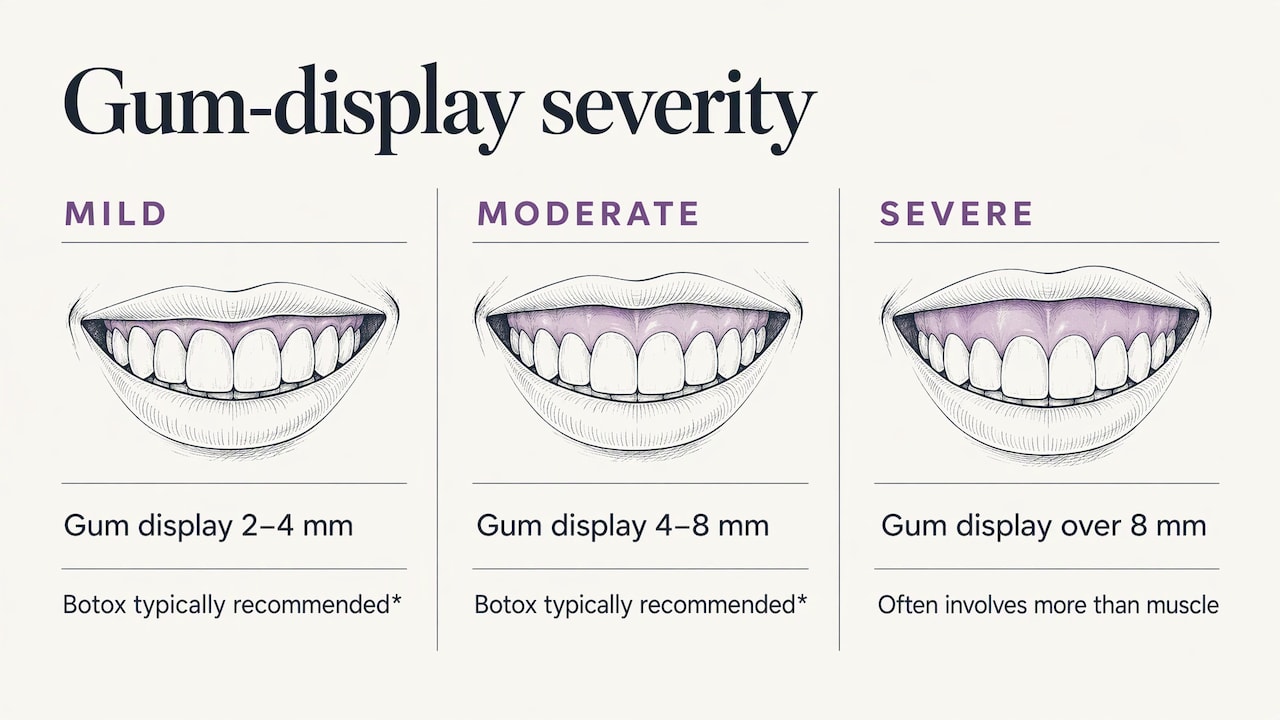
A 2024 paper in Seminars in Orthodontics grades severity as mild (2 to 4 mm), moderate (4 to 8 mm) or severe (over 8 mm). It notes that Botox is typically recommended for mild to moderate cases caused by a hypermobile upper lip. Severe cases often involve more than muscle.
How Botox corrects a gummy smile
Botox temporarily weakens the small muscles that lift the lip: the levator labii superioris alaeque nasi, the levator labii superioris and the zygomaticus minor. With less pull, the lip rises less and covers more gum.
The 2026 review describes three injection strategies:
- Single point (the Yonsei point): one injection per side, about 1 cm to the side of the nostril along the nasolabial fold.
- Multi-point: several injections for wider or posterior gum display.
- Lip flip: a small dose in the upper lip muscle that rolls the lip slightly outward.
A 2025 systematic review suggests 2 units per side when display is under 5 mm, 2.5 units for 5 to 7 mm, and extra injections for more than 7 mm. These figures come from the research literature, and your own plan will depend on your assessment.
Why personalization matters
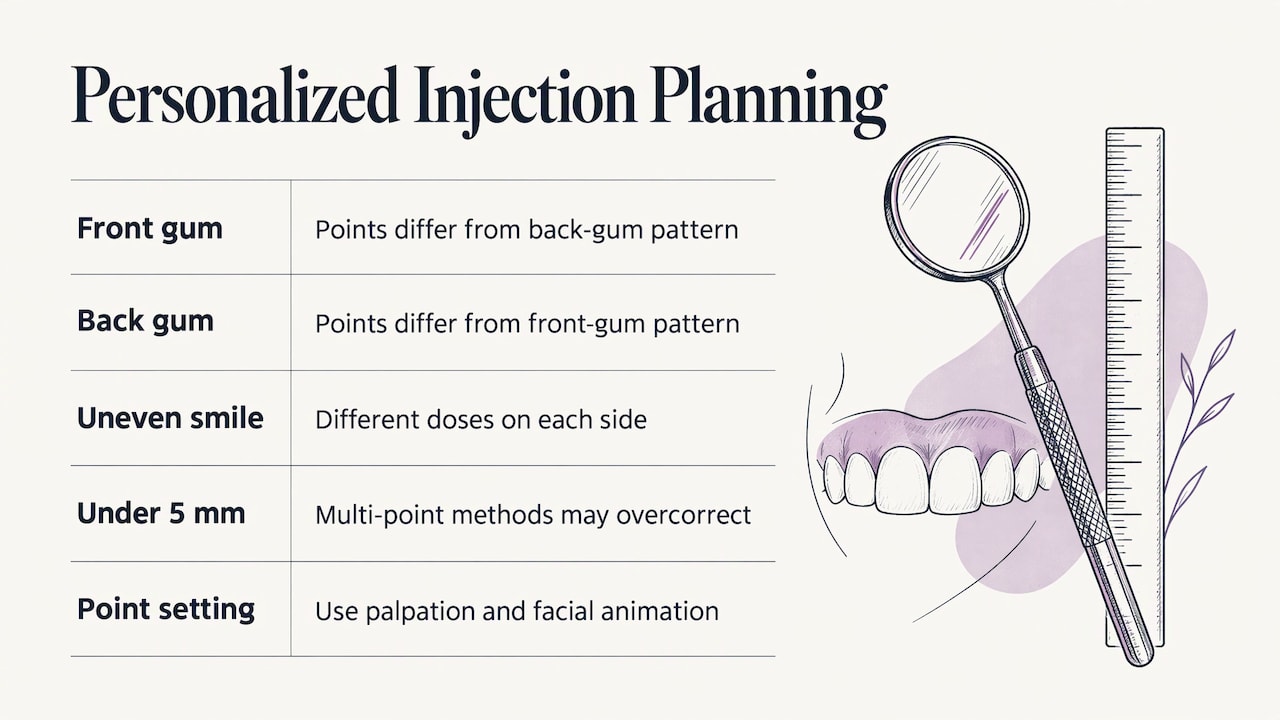
The 2026 review says injection planning should follow the pattern of gum display. Smiles with mostly front gum respond to different points than smiles showing gum further back. Uneven smiles need different doses on each side.
It also cautions that multi-point techniques can overcorrect when baseline display is under 5 mm, pulling the lip down too far. Polo's 2022 chapter adds that points should be set by palpation and facial animation, since facial type and proportions vary. This is the case for a trained clinician reading your smile, not a standard map.
Results: when they show and how long they last
Polo's chapter reports results within 2 to 5 days. In a 2008 study of 30 patients, average gum display fell from 5.2 mm to almost nothing at two weeks. The 2026 review suggests assessing at the two-week peak.
Duration varies between studies:
| Source | Reported effect |
|---|---|
| 2023 meta-analysis of 11 studies | Average reduction of 3.22 mm at two weeks and 2.70 mm at three months |
| 2024 randomized trial | Improvement at 4, 12 and 24 weeks, back to baseline at 48 weeks |
| 2022 one-year follow-up | Marked improvement at 14 days, with relapse from about 4 months |
Plan on roughly three to six months. Because the effect is temporary, many people book a repeat before the previous dose has completely worn off, within the minimum spacing below.
What the appointment involves
- Assessment. Your smile is examined at rest and at full smile, and the pattern of gum display is noted.
- Planning. Points and doses are chosen for your anatomy, with different doses per side if your smile is uneven.
- Injection. Several tiny injections take only minutes. Polo's chapter recommends ice before and after to reduce discomfort and bruising.
- Review. Results settle at about two weeks, which is when the effect is judged.
To reduce bruising risk, avoid rubbing the area right after treatment and follow the aftercare your clinician gives you.
Safety: who should not have it and what to watch for
The Health Canada product monograph for Botox Cosmetic (revised April 9, 2025) states that it must be given by a qualified physician or authorized prescriber, starting at the lowest dose. It also sets these limits:
- Injections no more often than every 3 months.
- Not for use during pregnancy.
- Not for use with an infection or hypersensitivity at the injection site.
- A boxed warning: toxin effects can spread from the injection site and, rarely, cause serious swallowing or breathing difficulty. Get urgent medical care if you notice this.
A 2025 narrative review also lists myasthenia gravis, Lambert-Eaton syndrome, product allergy and breastfeeding as contraindications. Tell your clinician about any neuromuscular condition and every medication before treatment.
Fatani's review lists the local effects that can occur: bruising, swelling, pain, and infection. Poor technique can affect speech or the symmetry of the smile, and cause drinking or chewing problems. This is why plans are made by an experienced clinical team. Spacing doses at least three months apart also helps limit the chance of antibodies that can reduce future effect, according to Hong and colleagues.
When Botox is one part of the plan
If your gum display comes from the jaw, the gum tissue or the teeth, the best answer may be dental or surgical. Botox can still play a part. The 2025 JCAS review notes it can support lip repositioning surgery when injected at least 48 hours beforehand to ease muscle tension during healing. For a dental or surgical cause, your dentist or oral surgeon is the right specialist to see, and your assessment will tell you which group you are in.
Cost in Toronto
Gummy smile treatment is priced by the unit. Our Botox / Dysport is $10-12 per unit, for both the under 20 units and 21 to 49 units tiers. A typical gummy smile dose in the research is 2 to 5 units per site, so total units depend on how many sites your smile needs. Your clinician confirms the number at your assessment.
Treatment at BOSS Aesthetics
Our approach is nurse-led, with a board-certified clinical team, medical-grade products and a clinically reviewed assessment that gives you a clear roadmap. If you want to keep results going, we offer preferred pricing and treatment credits for continuity of care. Our Injectables as a Service plan is $249.99 per month. See the full Botox and Dysport pricing, or explore Beauty as a Service plans.
If you would like your smile assessed, you can book through our Toronto clinic site.
FAQ
Does gummy smile Botox hurt?
Most people describe it as a quick pinch. Ice before and after, as Polo's chapter recommends, helps reduce discomfort and bruising. The treatment takes only minutes.
Is it permanent?
No. Effects are temporary, usually 3 to 6 months in the research, and the 2024 trial saw a return to baseline at 48 weeks. Repeat treatment keeps the result going.
Can Botox make my smile look strange?
It can if the dose or points are wrong. The 2026 review warns of overcorrection with multi-point techniques in mild cases. A tailored plan, with reassessment at about two weeks, is designed to prevent this.
How soon can I have it repeated?
Health Canada's monograph sets the interval at no more often than every three months.
Sources
- Cosmetic Management of Gummy Smiles with Botulinum Toxin A (2026)
- Fatani, An Approach for Gummy Smile Treatment Using Botulinum Toxin (2023)
- Cosmetic Treatment Using Botulinum Toxin in the Oral and Maxillofacial Area
- Gummy smiles: Etiologies, diagnoses and formulating a treatment plan (2024)
- Gummy Smile Treatment systematic review (2025)
- Polo, Botulinum Toxin and Smile Design (2022)
- Polo, Botox for the neuromuscular correction of excessive gingival display (2008)
- Rojo-Sanchis et al., Non-Surgical Management of the Gingival Smile (2023)
- Gong et al., Botulinum Toxin at the Yonsei Point (2024 trial)
- Adel, A Standardized Technique for Gummy Smile Treatment (2022)
- Health Canada product monograph, Botox Cosmetic (2025)
- Botulinum toxin treatment of the orofacial region, JCAS (2025)